





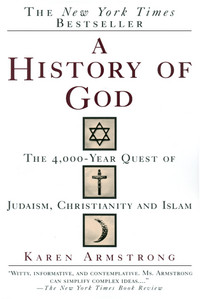
A History of God by Karen Armstrong
Karen Armstrong, a pioneer in explaining Islam to the West, goes through a thick timeline of the development of the notion of God as God appears in all three "major" religions. The book is very thorough in its history, sometimes to the detriment of style, but it is worth reading just for her ability to point out the similarities existing in the three faiths.
A British-born Catholic, Armstrong joined the a convent in the Sisters of the Holy Child Jesus, the same order as my dear Aunt Eileen. She became notorious for her book about her time in the convent, which is extremely critical. Although she has been reviled by British Catholics, my aunt says the American nuns in her order love Armstrong. At times, her books sound as if she is favoring Islam, and she could be a Muslim, but she calls herself a "freelance monotheist."
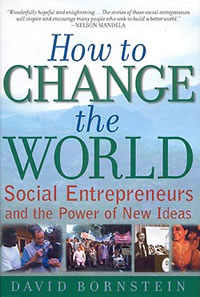
How to Change the World: Social Entrepreneurs and the Power of New Ideas by David Bornstein
A rather ambitious title. But fair enough. Let idealists be idealists. It more or less presents the views of the organization Ashoka, which advocates for social entrepreneurship. The idea is to make organizations that have goals to alleviate societal problems to move from a charity-based mindset to sustainability and large-scale change. In other words, create successful businesses that have a mission to solve a problem at a national or international level. It's not a perfect solution, but neither is the world perfect. And the people who create such organizations are certainly admirable for their efforts.

Mezzaterra: Fragments of the Common Ground by Ahdaf Soueif
Soueif composes a unique collection of essays about her homeland Egypt, mixing the vibrant color of Egyptian society with contempt at its character faults and arrogance of foreigners. At times the sketches are full of tragic comedy, often reflecting the Egyptian spirit of finding humor in difficult circumstances. She finds unique characters and typical prototypes and merges them in a world full of ostensible nobility. It's a good book when you only have a few minutes and want to read a short narrative.

Making Globalization Work: The Next Steps to Global Justice by Joseph Stiglitz
Stiglitz presents somewhat of a critique of globalization, at least refuting the wave of pundits who say the world has benefited greatly from global trade. Neither truly radical nor conservative, Stiglitz gives an introduction on how to make capitalism a bit more fair for the majority of people on the planet from the view that the current problems are unsustainable if not addressed properly.

The Shah of Shahs by Ryszard Kapuscinski
Considered Kapucinski's finest book, the Shah of Shahs recounts the last days of the controversial Shah of Iran before the Islamist coup in the end of the 70's. Although some of his facts are a bit skewed to one side, that is, against the Shah, the book is a very interesting tale of life under a fading and distant dictator. I admire Kapuscinski's guts as a journalist, and respect his insight, particularly in this book, in which he notes that the Islamists were able to take power because of their modesty and proximity to many of the regular people of Iran.

The Alchemist by Paulo Coelho
A lovely tale of a young man who leaves Spain in search of a treasure through North Africa. Coelho has a masterful power over words through simplicity. His prose is flows smoothly and his messages inspiring. This book is his most famous, and a quick read. Certainly a good introduction to the author, who has been translated all over the world. It's a very easy read with a simple message: happiness is not found outside yourself.
.
The Iraq Study Group Report
by James Baker, Lee Hamilton and Co-Chairs
An interesting read for those looking for an assessment of the war in Iraq. It outlines many of the strategical errors of the Bush administration and military brass. What I liked most about it, however, was it's practical outline of suggestions for improvements. Too often critics offer only harsh words, but no suggestions, even if those suggestions come from a specific framework.
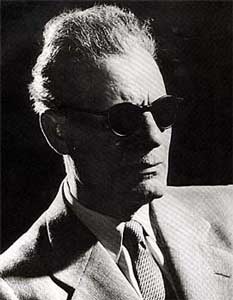
The Dreams of Scheherazade by Taha Hussein
Taha Hussein, or the "Dean of Arabic Literature," was a blind novelist, essayist and journalist in Cairo in the early-to-mid 20th century. He wrote for the largest and state-run newspaper Al Ahram. He was a political dissident who published many iconoclastic articles.
In this book he tells the story of a king, Shahrayer, who sits beside the bed of his queen, Scheherazade, and hears the story of a mythical kingdom in which the princess attains great magical powers to fight demon-kings who desire to destroy her kingdom and take her hand in marraige. After several nights of listening to his queen's tales, Shahrayer finds himself in a strange dreamland where Scheherazade tries to tempt him with all sorts of aestetic pleasures. It is not until the end of the novel that the reader discovers the real motive of the author; the dreams of the queen are symbolic of the king's disconnect from his subjects and the dreamland he visits serve to illustrate this. Hussein therefore was probably cricizing the monarchy that ruled Egypt living in ostentatious disengagement from the vast majority of Egyptians. The book is a translation from the Arabic original, so the language is a bit flowery, but overall it's very interesting imagery.

Jane Eyre by Charlotte Brontê
A few years ago I started on a kick where I would read so-called classics that I never read either because I didn't care about them when I was in high school or never got around to it. Ironically, one of the first books I read was Wuthering Heights, which was written by Charlotte's sister Emily, although I didn't know this when I picked up Jane Eyre. The book itself sometimes smacks of cheesy romance novel dressed in beautifully-written prose, but the skill of Brontê cannot be underestimated. Besides being one of the few female authors of her time, she also makes several modern statements about women that still have yet to reach the minds of the masses.
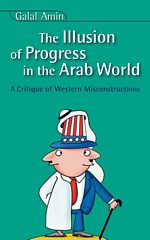
The Illusion of Progress in the Arab World: A Critique of Western Misconstructions by Galal Amin
Amin, an Egyptian economist at the American University in Cairo, refutes a number of terms and social conditions attributed to people living in "Arab world." Amin rejects two common terms: progress and development. Amin questions the idea of progress itself, wondering if human progress is possible, and if so, if we have really progressed despite technological and scientific advances. The ancient Greeks-- who, if we are to judge based on their greatest thinker, Socrates-- were likely as advanced (if not moreso) in human sociology as current human beings. They believed that human progress was cyclical: we progress in stages of ups and downs. Therefore, with all the distractions and entertainment we have today, we may be facing a period of decline. He also rejects the notion of development, theorizing that it is put in a western framework and cannot be accurately applied to people outside of the western world. Western development as applied to Arabs and Egyptians come with a tradeoff. Amin questions western values, not necessarily for their inherent value in western countries, but for their value to other societies. He also believes western values come on an uneven playing field because they originate from countries with greater economic and military power.
I interviewed Amin for a story and I thoroughly enjoy his perspective on the world, and his persistent attitude of questioning commonly accepted ideas. He seems to have rejected western values in reaction to his father's attitude, which was to embrace the West. I respect his dignified position towards Arabs, Mulsims and people living in the Middle East, but I disagree with his views on women, which tend to be traditional.
 Anyone remember this show? Yes, I'm dork, but now that I'm an adult (sort of) I can say that reading is cool.